Last time round I started to take a look through the Tackle Box I use for my carp fishing. As I said then, my tackle box is actually a storage container from B&Q and it looks exactly like a medium/large fox tackle box but costs a lot less!. I try to keep the amount of tackle I carry to a minimum but despite this the sheer amount of items I carry means that this simple look through my tackle box has spread to more than one diary entry and in all honesty its likely to go further than that as there’s a lot of bits and pieces.
My Carp Tackle Box and Tackle Bits and Pieces
Kryston Mantis
I’ll continue this look through my tackle box by looking at another hook length material, this time it's Kryston Mantis, a coated braid that comes in very handy for me in certain circumstances. If you’ve read any of my previous blog entries you’ll know Kryston Silkworm is my all time favourite hook length material. Silkworm is a very supple material and its not the best material for avoiding tangles at range. If I have to fish at any kind of range I generally change to Mantis. I leave most of the coating on and just strip back enough to make the hair and maybe an inch or two extra behind the hook to create a hinge. By using Kryston Mantis for my long range fishing rigs I find I can avoid tangles a lot more and you really need to know your rigs are sitting right at range. Mantis does this job really well and I’d recommend you give it a go on your long range setup, as with all Kryston products Mantis is very well made and completely reliable.
Kryston Mantis Coated Braid, my second choice after Silkworm
Kryston Heavy Metal Rig Putty
Whilst we are on the subject of Kryston products, I have to say I’m a big fan. I’ve been using Kryston fishing tackle for as long as I’ve been carp fishing. My next item in the tackle box is one of theirs too and that’s Heavy Metal Plus Putty. I tend to fish a lot with pop-ups and baits that are critically balanced so they sink very slowly and heavy metal putty is excellent for balancing out buoyant baits. Heavy metal grips braided lines like Silkworm and Mantis very well and it’s a pretty dense material compared to most rig putty on the market today so you don’t need to use as much of it, which is a bonus. I use pop-ups so much that I’d never not have a tub of heavy metal in my tackle box, it really is a great product.
Kryston Heavy Metal Plus Popup Rig Putty, excellent!
Carp Rig Tubing
Rig tubing is very much a personal thing and I tend to avoid branded names. As long as it sinks well and it's dark brown or khaki to blend in with the bottom I'm happy, usually I choose rig tubing that's unbranded or not from a very well known carp company as there's usually less carp tax on it.
Lead Weights
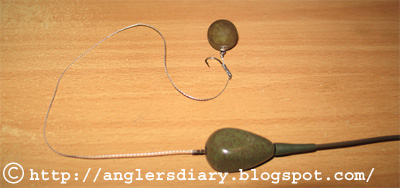
You’ll notice my tackle box doesn’t have many lead weights in it. When you’re travelling light ditching lead weights from your tackle box and rucksack is a real saver on weight. You can end up carrying round pounds and pounds of lead if you’re not careful and I’ve fallen into this trap myself in the past. These days I almost exclusively use Inline Leads and rig accessories like Rig Tubing, Carp Rig Swivels and Tail Rubbers. I used to make my own lead weights years ago and still do now and again. I still carry the odd one with me today. Making your own leads is actually quite easy to do but it can be messy and its not without its problems safety wise, if you‘d like to know more about making your own have a look at my Making Leads Blog Entry from a year or two ago.
Square Pear Lead, my favourite lead weight
I’ll have to stop this continuing look through my tackle box for now as this entry is starting to get a bit long, in the next few weeks I’ll continue looking at my tackle in detail as there are some other useful bits and pieces that I carry with me, I haven’t looked at hooks yet either and I’m wondering if that wouldn’t make a whole entry on its own!. Next time I sit down to write in a couple of weeks time I’ll see how things go and if I can keep my comments on hooks to a minimum I’ll include them in my tackle box series, otherwise a look at hooks will come as a separate entry at some point in the future.
Until next time, tight lines.
Mark.
One things all carp anglers have in common is their tackle box. I was fishing last weekend when one of my mates popped round for a chat and a brew. I’d not long finished setting up and my own tackle box was out in full view. As he sat down on my guest chair he commented that all anglers like routing through other peoples tackle boxes and promptly started routing through mine whilst I made a brew.
I’ve actually got no secrets as far as my carp Tackle Box goes, it’s a pretty standard tackle box that just contains the bare essentials and little else. I like to keep my fishing simple and my tackle box is reasonably small on purpose. There’s nothing worse than carting round a whole lot of tackle that you’ll never really use and by keeping my carp tackle box to a single layer medium size I can just carry the rig and end tackle bits I need without getting carried away!.
B&Q Storage Container is not unlike a System Fox Tackle Box!
My carp tackle box itself is one of those storage containers you get for nails and screws!. I’d really recommend anglers have a look in B&Q before you go and spend silly money on a system fox box or similar tackle box. My tackle box actually looks just like a medium fox box from the outside, the only real difference was the price!. Whilst a fox box will can set you back anything from £20-£50 depending which one you buy, my B&Q version was just £4.95!. That’s not a miss print, four pounds and ninety five pence was how much my tackle box cost!. I’m sure I’m not the only one that’s latched onto B&Q storage containers, I regularly see Tackle Boxes on ebay and they look just like mine, if you can’t be bothered heading for your local DIY store then the old faithful ebay is well worth a look if you're considering a new tackle box or you’re on a budget.
For the next couple of blog entries I’m going to be taking a look at exactly what’s in my tackle box and I’ll start with ESP PVA String. ESP have been around for quite a while now and they have built themselves an excellent reputation for quality PVA string and mesh. I always have a spool of ESP PVA knocking round in my tackle box, it’s ideal for making stringers and it’s cheaper than most other brands of PVA.
Kryston Greased Lightening Turbo Juice. Greased lightening is a cracking treatment for your mainline. If you ever find yourself in the position of needing every last single yard to reach the fish this stuff can help, it actually reconditions your mono and cuts down on friction as your line passes through your rod rings, the result is extra yards on your cast and this can mean the difference between success and failure. Greased lightening has certainly helped me put a few bonus fish on the bank over the years!.
Kryston Greased Lightening Turbo Juice for extra yards on the cast.
Korda Extenda Stops. Korda developments are probably the biggest tackle manufacturer in carp fishing today, despite this I’m not a big fan of korda tackle, it’s mainly their leaders I have a problem with but credit where it’s due, these extenda stops are a fantastic little invention. They allow you to change the size of baits on a hair rig without actually re-tying your rig. I doubt I’ll ever be without a couple of different sized packets of extenda stops in my tackle box, for once korda have got something absolutely right.
Korda Hybrid Extenda Stops, an excellent addition to your tackle box.
Kryston Silkworm Braided Hooklength. I’ve reviewed kryston silkworm before on this blog. There’s nothing more I can add to my origonal review of this hooklength material. It’s simply my favourite hooklength braid and has been for the last 15 years. My confidence in this material is absolute and despite many other hooklength products coming onto the market, silkworm has remained my number one hooklength braid.
Kryston Silkworm Hooklength Braid, total confidence for me!.
Sometimes it’s difficult to keep my blog entries to a reasonable size and trying to cover what’s in a carp tackle box in one go just isn’t possible so I’ll stop writing here and continue looking through my tackle box next time.
Tight Lines
I’ve been meaning to sit down and write a blog entry about leadcore and carp fishing for some time now, literally since this blog started in fact. To be honest, I’ve ducked out of doing it far too often so it‘s time I had my say.
Why have I ducked writing about leadcore and leaders?. Quite simply because I can’t stand them!. I don’t think there are many things in carp fishing that present such a danger to our carp but leadcore leaders are right up there at the top of my ‘most dangerous’ list. I don’t believe leadcore is being used safely and I’m not sure it actually can be!, although some ways are safer than others.
Click to watch a video of my leadcore free carp rig
I’m an old school angler and when I learnt to carp fish I learned to follow some simple rules, always find the carp being one, keep quiet and keep your movements to a minimum being another. Simple common sense things that all anglers should strive to do. Another simple rule I learnt fairly quickly was the simple rule of thumb for shock leaders and that is….if you don’t need one, don’t use one!.
The thinking behind the old school leader rule was safety, even back in the late 80’s intelligent carp anglers knew that shock leaders could cause problems in the event of the anglers main line breaking. So where did we go wrong?. Knowing that shock leaders had the potential to cause trouble, how did carp fishing end up down the leadcore leaders route and why do anglers think they are actually safe to use?.
I’ve seen many arguments about leadcore on the fishing forums and not once has a leadcore user actually put up a reasonable argument for using them. The only advantage in using leadcore is that it’s weight keeps the last 2-4ft of your line/rig on the bottom, that’s it, it serves no other purpose than to try and conceal your carp rig.
So we know the one advantage of leadcore but why is it so dangerous?. In order to understand what makes leadcore so deadly, you have to think ahead in your rig tying and question what you are doing, why you are doing it and what effect your rig might have in the event of your main line breaking?. After all, its when your mainline breaks that the dangers start.
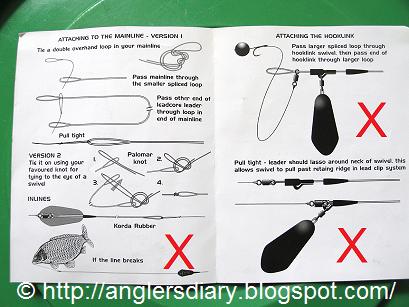
Below is a picture of the instructions inside a gravel / khaki leadcore leader packet. As you can see, the leader is spliced into a loop and the angler is supposed to pass the leadcore through the hooklink swivel then pass the end of the hooklink back through the larger loop. This is then fished with a Safety Lead Clip or inline lead but both ways of setting up the rig mean that the carp will still be left towing the leadcore round in the event of the main line breaking?. In my view, this is simply not acceptable and the red 'x' marks are the instructions I firmly disagree with!.
Leadcore instructions, not as safe as they appear to be!
Given that leadcore is heavy and usually around 35-45lb in breaking strain, ask yourself if a carp can break free from this setup should it ever get snagged?. What will a carp do when it’s hooked and lost? The simple answer is that it will head for a ‘safe’ area of the lake which will usually be the snaggiest area it can find!. It doesn’t take a genius to work out that a fish in a snaggy area towing round a 3ft length of 35/45lb leadcore is potentially at risk, even if the lead weight is lost from the set up, that 3ft or so of leadcore is still there and if a carp does get tethered the chances are it will die of starvation. As an angler, do you really want to put the carp you fish for at risk like this?.
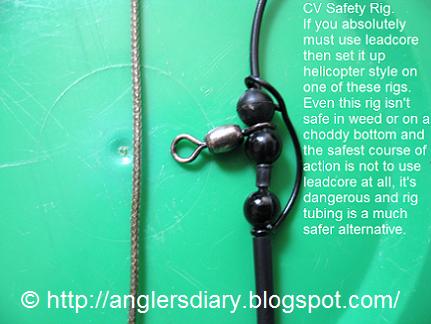
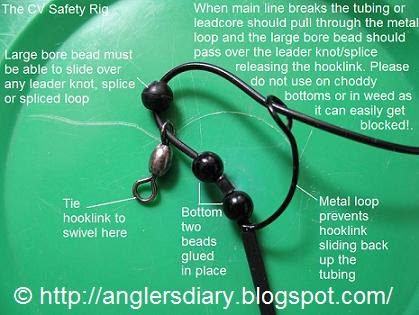
No angler should ever use leadcore that’s attached direct to the swivel of a rig as per the instructions above!. When your mainline breaks, the carp should be left with nothing more than the hooklink and as responsible anglers, it’s our duty to fish our rigs as safely as we can. With leadcore, the only way this can be achieved to any degree is with the use of a helicopter rig, specifically the old CV safety rigs that were designed for safe shock leader use in the early 1990’s. At least with a CV safety rig the carp has half a chance of getting rid of the lead and the leadcore but if I’m honest, even this rig has the potential to cause problems if its used on a choddy bottom or in weed.
CV Safety rig, not ideal but the safest way there is to use leadcore, just substitute the black tubing for leadcore.
How the cv saftey rig works, the whole rig gets dropped leaving the carp with no leadcore to get tethered on.
As you can see from the pictures above the CV Safety rig can leave your carp with just the hooklink in the event of your main line breaking, providing your lake bottom is firm and clean.
I’ve read the comments of pro leadcore users saying leadcore is safe if it’s tied up correctly, others have said their rigs are ok because they use a low breaking strain of hooklink or a barbless hook and that education is better than an outright leadcore ban. Come on guys get real!, barbless hooks have their own mouth damage problems and low breaking strain hooklengths are only really usable in open water fishing situations. Even then, they may still be strong enough to stop a carp from breaking free if it gets tethered.
Leadcore causing carp deaths really came to light in the early to mid 1990’s when the very high profile ‘arnie’ the 40lb common from orchid lake in Oxfordshire was found dead tethered to some reeds, it’s now 2008 and just recently the high profile Chilham Mill in Kent has just joined a growing list of fisheries that have banned leadcore after two of their precious carp were found dead tethered to snags. Clearly education doesn’t work and why would it when the instructions in the packet say its ok to leave your carp trailing a leader when your main line breaks?!. People come and go from carp fishing and education is always ongoing, in the meantime, carp like arnie the orchid common and the Chilham fish will continue to be lost!. Education is really just a lousy excuse for anglers to keep using leadcore in the mistaken belief that what they’re doing safe. Well it’s not and if you’re pro leadcore please think long and hard about using it because it’s simply not necessary in the modern carp world.
So if leadcore isn’t safe to use what do you do?. Well the daft thing is leadcore itself has been redundant in carp fishing for some time now, Rig Tubing has advanced to the stage where it’s now several times heavier than leadcore so it sinks like a brick and keeps your line on the bottom better than leadcore itself. Sure you have to go to the trouble of threading rig tubing onto your main line but isn‘t that better than risking another Chilham or an Orchid lake scenario?. Rig tubing also comes in a variety of colours too, black, clear and a whole host of different shades of green make it easy to conceal your carp rig from shy feeding carp.
ESP anchor rig tube, just one of the new types of rig tubing that leaves leadcore redundant in modern carp fishing.
Please ask yourself the old school question next time you go fishing, do you really need to use a leadcore leader?. I think any intelligent reader already knows the answer to that question. You don’t need a leadcore leader, so please don’t use one.
Thanks for reading.
Tight Lines
Mark.
A few months ago I joined a north west carp syndicate, one of the rules of the syndicate was that no long shank hooks were allowed. No long shank hooks was a pretty vague statement so I read the rules closely and it was recommended that a hooks shank should be no longer than that of a drennan super specialist hook. I knew straight away that this meant my beloved Kamasan b175's were on the banned list of carp hooks I could use for the syndicate and it sort of left me with a bit of a problem. I’d been using the kamasan b175’s in conjunction with a knotless knot since 1995 and my confidence in this hooking arrangement is extremely high, its probably the most efficient carp rig I’ve ever used!.
Prior to my usual carp rig, I’d actually used drennan super specialist hooks and as they were on the approved list for the syndicate it seemed logical to go back to them and fish with the rig that Jim Gibbinson made famous in the early 90’s, the line aligner. The line aligner and the knotless knot/b175 setup are very similar and they both work the same way, in fact I only switched to using the knotless knot because it was so easy to tie, both rigs are extremely efficient hookers of carp so it was no great hardship to use the line aligner again.
Tying the line aligner is reasonably straight forward, I actually start by tying a knotless knot the same way I would if using the b175’s. With a b175 the rig would be finished at this point but unlike the b175, the drennan super specialist hooks don’t have the 45 degree down turn on the eye that gives the rig the ability to flip over. This ability to flip comes from adding a piece of 1mm soft rig tubing which both extends the shank and adds the flip effect.
Knotless knot ready for the 1mm soft rig tubing that forms the line aligner
With the knotless knot tied I take a needle and thread the other end of my silkworm hooklink through the eye. At this stage I thread the needle through the tubing and bring the needle out through the wall of the soft tubing as can be seen in the picture below, pull the needle out so that hooklength runs through the tubing and exits through the tubing wall.
Threading kryston silkworm through the tubing wall
At this point the tubing can be slid down over the hook shank and manipulated so that where the silkworm hooklink exit’s the tubing wall is on the ‘inside’ of the hook eye the same as the knotless knot.
The tubing positioned so the silkworm exits on the inside of the hooks eye
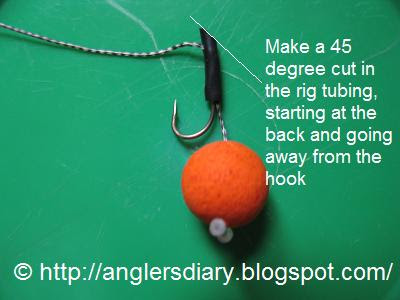
Once this is done the rig is completed by cutting a 45 degree angle in the end of the soft rig tubing, the angle of cut is vital and the best way to describe this cut is to refer you to the picture below. As you can see the line comes out of the tubing on the inside of the hooks eye and the 45 degree cut in the rig tubing is on the opposite side going away from the hook.
Cut the tubing at a 45 degree angle and the rig is complete
Once the line aligner rig has been tied you can try the finger test on it. Pull the silkworm hooklength over your finger and try to manipulate the hook point so that its always away from your finger and won't catch hold. The hook point will always stay away until you hit the 45 degree cut in the rig tubing, at this point the rig will always turn and dig into your finger and you’ll never actually manage to pull it over your finger without it flipping and catching hold.
Try the finger test, the rig will always turn and dig into your finger.
I believe the line aligner works on the basis of the carp not actually knowing it's picked up a hookbait, hooking occurs when the rig actually tightens to the lead. The knotless knot works the same way, the 45 degree down turned eye on a kamasan b175 hook has pretty much the same effect as the 45 degree cut in the rig tubing on the line aligner. Both rigs are extremely efficient hookers of carp and having switched back to the line aligner for syndicate use I’ve remembered just how happy I was with this rig for catching carp.
For 95% of my carp fishing I use a bog standard knotless knot hair rig. There aren’t many occasions when I’d actually need another rig, I’ve tried a few different rigs over the years and whilst some of them have worked in different circumstances my standard hair rig is still the one I use the most.
One rig that did make a positive difference in my carp fishing was the D Rig. I was fishing that well known Cheshire carp water capesthorne hall at the time and the fishing was difficult to say the least. I was getting very few runs despite being on fish every session. I came to the conclusion that the carp must at least be picking up my hookbaits but somehow getting away with it and cleaning me out of bait. On a normal carp water that hasn’t been subject to the same kind of angling pressure capesthorne has, the knotless knot hair rig was fine but these capesthorne fish were extremely crafty and I found myself struggling.
The answer to my problem came in the form of a variation of the famous d rig that was known as the ‘reflex’. This particular version of the d rig was commercially available from a tackle company called big fish adventure, it was made using my favourite Kamasan B175 Hook and involved whipping a small length of amnesia line to the back of the hook with the ‘hair’ itself being made from a loop of Drennan Double Strength that was passed through the amnesia ‘D’, tied at the required length and glued so it didn’t come undone.
Big fish adventure kamasan b175 'reflex' D rig
I went from carp showing over my baits and no action to carp showing over my baits and plenty of runs so the rig definitely worked. On close examination it’s obvious that the stiff Mono and Amnesia looped together allowed for more movement of the hook bait than the conventional hair rig and I think this extra movement certainly had a big hand in tripping up those cute capesthorne carp.
The next step after using the big fish adventure version of the ‘reflex’ d-rig was to tie my own as they were on sale at £3.00 for a packet of 5!. I bought some 30lb Amnesia, some fly tying cotton and a fly tying vice and set about doing them myself. The self tied d rigs worked a treat and in the long run they saved me quite a bit of money.
Home tied carp 'D rig' using amnesia and fly tying cotton
If you look closely at the above picture you can see that my Kryston Silkworm hooklength is actually tied to the shank of the hook just underneath the whipping then threaded back through the eye of the hook. With the hooklength coming off the inside of the eye like this you get the same ‘flip’ effect that the knotless knot and the line aligner both rely on. The advantage of this rig is the extra free movement of the hookbait that comes from the stiff amnesia and the 8lb mono being looped together, if you put one of these rigs next to a conventional hair rig you can see the difference straight away.
I’ve never needed to use this d-rig variation very much, apart from capesthorne I generally tended to use it on pressured day ticket waters where the carp had a reputation for being cute, linear waters like hardwick and st johns being good examples, this rig worked a treat on those two particular carp waters and I caught well from both after ringing the changes and switching to the d rig. If you're fishing a pressured water then give this rig a try. I’m not sure if big fish adventure still sell the Kamasan B175 hooks already whipped but they are easy to do yourself. I found that using the fly tying vice and tacking the amnesia in place with superglue prior to whipping was a big help.
Although I don’t use this rig that often I always have a few b175 hooks already whipped up and sitting in my tackle box just in case, the rig has done me proud on pressured carp waters and it’s definitely worth trying if you think your carp are clearing you out of bait on a regular basis and not getting hooked.
Tight Lines
Mark.
I thought I’d share my thoughts on carp rigs this week but to be honest I've not got that many strings to my bow when it comes to rigs for catching carp. I have a handful of rigs that i know work and work well and I've stuck with these rigs for many years. Before I continue looking at my basic carp hair rig, can I also recommend you take a look at my Safe Carp Rig too.
Click to watch a video of my current basic carp rig
Probably the best advice I’ve ever seen when it comes to carp rigs is ‘kiss’, short for keep it simple stupid!. This has been my approach to carp rigs for well over a decade now, in fact I’m using the same rig now in 2007 that I settled on way back in 1995!. I do have the odd phase when I try something new, I’ve had a dabble with a couple of different versions of the stiff rig, I’ve tried the chod rig too but both of these rigs have come up short for me and I’ve always ended up back on my old favourites.
When it comes to hook length materials I’ve used and would recommend the following... Kryston Silkworm Kryston Snakebite Kryston Snakeskin I've also used armaled kik-bak and this is worth a look too, it's described as a coated, fast sinking braid and I like the drab dark green colour it comes in. Kik-bak is a hook link material I've found particularly good for short rigs and it provided me with the answer to a problem of some rig shy carp on one of my local waters but I'll talk about that some other time.
Despite various experiments over the years, I always seem to end up back on a basic knotless knot setup tied with one of the materials above with 25lb kryston silkworm being my favourite. I’m not sure what it is about silkworm but it does seem to trick the carp and I have a lot of confidence in this particular hook length material, specially when it’s used as part of my favourite carp rig the knotless knot.
Probably the most important part of any carp rig is the hook and for me, the Kamasan B175 trout hook is perfect, it has a long shank and a down turned eye and combined with a thicker braided hook link material like silkworm it makes a very effective setup. The kamasan b175 trout hooks are also cheap, I bought my last box from a trout fishing ebay shop and they cost me £7 delivered for a box of 100 hooks, very favourable compared to the fishing tackle shops who charge upwards of £3 per 10 hooks just because they are aimed at the carp market!.
Basic Knotless Knot Carp Rig I Use Most
Above is the basic carp rig I’m using at the moment. I usually use just a knotless knot for straight bottom bait presentations but the rig in the picture above has a Rig Ring that’s been incorporated into the hair. This is the one modification I’ve made to the basic knotless knot rig and it’s been done because I do the majority of my carp fishing with buoyant hook baits or pop ups. The basic knotless knot hooking arrangement is the same but my pop up hook bait is tied to the rig ring rather than the conventional way of putting a bait on the hair using a baiting / boilie needle. Set up this way I have more flexibility when it comes to presentation, I can mould my kryston heavy metal putty round my hook link and be fishing a popup or, if I want to fish a bottom bait, I can mould the putty round the rig ring to create a buoyant or balanced bottom bait without changing rigs. I find this useful especially as I’m mainly a short session carp angler who may need to chop and change to find the right presentation that works on the day.
For the record, the hook bait on this particular rig is a ccmoores odyssey xxx popup and its been tied to the rig ring using un-waxed dental floss, I cut a small groove around the popup with a knife, the dental floss sits in the groove so the hook bait won’t come off. This seems to have worked very well for me. The hook is my usual kamasan b175 in size 6, I’ve found a 6 to be just right for this particular hook pattern, the wire is too thin on a size 8 and whenever I’ve used an 8 I’ve had problems with them starting to open up. The size 6’s have been fine for all my open water fishing and I’ve banked so many carp on them that I have complete confidence in using them. My rigs are generally 8-10 inches long, this seems to be about the optimum length for getting pickups and not loosing fish, a Size 10 Swivel completes my hook length and I’ll fish this rig on either a swivel lead and Safety Lead Clip setup or an inline lead. Whichever lead setup I choose I always use Rig Tubing and not leadcore to finish my setup off. I see little advantage in using leadcore when rig tubing sinks anyway. I consider myself to be a reasonably experienced carp angler and despite me having been carp fishing for 18 years now, I’m honestly not sure I could tie a leadcore setup safely so I choose to avoid them and I’d recommend other carp anglers do the same.
Basic Carp Rig For Popups and Bottom Baits
Minus the heavy metal putty, the carp rig in the picture above is my complete setup ready to cast out. I sometimes make my own leads but since using the internet I've been able to source lead weights cheaply and the weight in this picture is a 2oz inline square pear lead from Ebay. You may notice that the hook length is not weighted in any way at all. Kryston make a couple of products called ‘drop em’ and ‘hawser’. These products are sold to carp anglers as must use products to keep your hook link pinned to the lake bed and in my early years of using this rig I religiously used them to keep my hook lengths pinned down. It was a chance session on Capesthorne Hall main lake that made me change my mind about drop em and hawser rig glue. I was using the D-rig at the time and I used to prepare hook lengths in advance so I’d always have a replacement on hand. I had a good day on Capes main lake one day and I run out of prepared rigs. I had no choice but to tie one up on the bank but getting the drop em onto the hook link and treating it with hawser wasn’t really an option on a short day session so I just tied the rig and cast it out. I’m sure you know what happened next! A run from a carp, followed a short time later by another!. Now Capesthorne is a tricky water, 6 fish a year if you’re lucky and I managed two carp in quick succession without having my hook link pinned down. During the next week I was busy and didn’t have the chance to prepare any more rigs so the next weekend I cast out the same rig without the weighted hook length and I caught again, from that day I never put krystons drop em or hawser on any of my rigs again. I’ve had no problem picking up carp, my run rate on Capes main lake never suffered and considering how much pressure those carp see, in my eyes, it proved these products just weren’t needed.
I guess stiff rigs and chod rigs are all the rage these days but I’ve been around long enough to know what works for me, I land upwards of 95% of my runs on the rig above with very few hook pulls and that’s good enough for me. A carp rig that’s so efficient means I can forget about my hooking arrangement and concentrate on finding the carp which to me is a lot more important.
Easy to tie carp rigs for beginners, click below to watch
A Big Linear Fisheries Carp of 23lb 4oz taken on the basic hair rig outlined above.
Next week I'll be starting my winter carp diary, catching north west carp in winter is no easy task but I usually manage a few fish throughout the colder months and through my winter carp diary I'll show you what I catch and how I go about my carp fishing at this time of year.